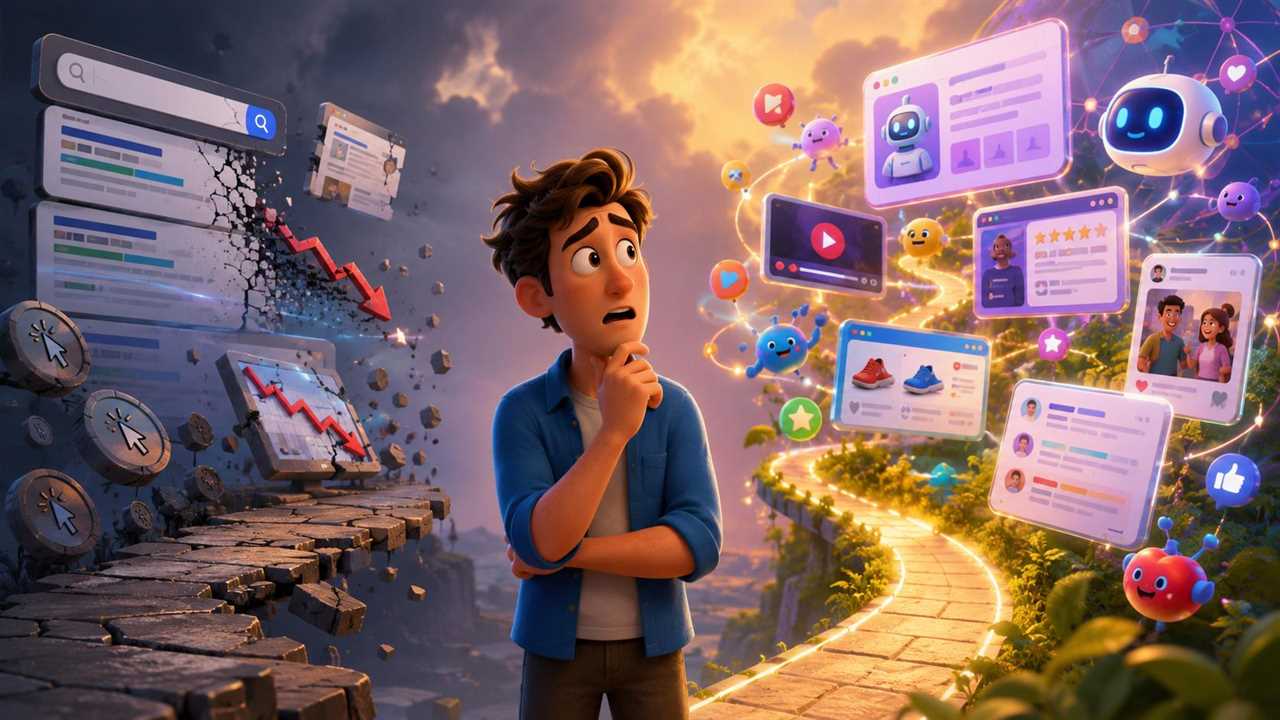
SEO used to feel simple. Rank high on Google, earn clicks, and grow traffic. But that old formula has become less predictable. Many websites that performed well for years have seen traffic drop, rankings shift, and click-through rates decline.
The rise of AI Overviews has made this even more unsettling. When search engines answer questions directly on the results page, users may not need to click a website at all. According to the source material, one study showed the number one ranking page losing about 35% of clicks when an AI Overview appeared, and a later rerun showed that loss increasing to 58%.
That sounds alarming, but it does not mean SEO is dead. It means SEO has moved beyond the old idea of simply ranking a webpage.
Discovery Happens Across Many Platforms Now
People no longer research in one place.
Someone buying headphones might start with Google, scan a few list articles, check Reddit for real opinions, watch YouTube reviews, and then read Amazon reviews before making a final decision. That kind of journey is now normal.
“
Modern SEO is not just about traffic. It is about being discoverable wherever people and AI systems look for answers.
”
AI assistants are beginning to follow a similar pattern. They gather information from different places, including forums, videos, review sites, publishers, and niche websites. Different AI tools may also prefer different types of sources. One may lean on YouTube and Reddit, while another may rely more on publishers, news outlets, or regional websites.
This means your brand needs to be visible in more than one place. Your website still matters, but so do mentions on review pages, comparison posts, social media, YouTube videos, Reddit threads, and trusted niche resources.
Modern SEO is not just about traffic. It is about being discoverable wherever people and AI systems look for answers.
Brand Mentions Are Becoming More Powerful
The next major shift is brand visibility.
AI tools often break one broad question into many smaller related questions. For example, a query like “best smartphone for photography” may lead to related searches about low-light cameras, zoom lenses, product comparisons, and specific model reviews.
If your brand appears across the pages that answer those related questions, it has a better chance of being included in the final AI-generated response.
Start your weekend by connecting with like-minded professionals in our community. Find out the perks of our basic membership, network across industries, and build relationships to grow personally and professionally.
This is why brand mentions now matter so much. It is not enough to only build backlinks or publish content on your own site. You also want your brand mentioned on listicles, review pages, comparison articles, social conversations, and trusted industry websites.
The more your brand appears in the right places, the easier it becomes for search engines and AI assistants to associate you with your niche.
Traditional SEO Still Wins With Action-Based Searches
AI is good at answering informational questions, but it is weaker when the user needs to take action.
If someone searches for “what is compound interest,” AI can answer that instantly. But if someone searches for “mortgage calculator,” “backlink checker,” “snow removal service,” or “best email marketing software,” they usually need to click, compare, book, buy, or use a tool.
These action-driven keywords are still powerful opportunities for traditional SEO.
Before targeting a keyword, ask: can AI fully satisfy this search without the user clicking?
If yes, the keyword may be better for awareness. If no, it may still be a strong traffic and conversion opportunity.
The New SEO Strategy
SEO now requires three layers.
First, keep building strong traditional SEO with useful content, technical health, links, and search intent alignment.
Second, build brand visibility across the platforms AI and people trust.
Third, focus heavily on action-driven keywords where users still need to click.
The game has not ended. It has changed. The brands that win will be the ones that adapt from ranking pages to being visible everywhere discovery happens.
_15.gif?dx=1754999576092)
Frequently Asked Questions
Why does the article say SEO “escaped Google”?
SEO “escaped Google” because discovery now happens across many platforms, not just search results. People research through YouTube, Reddit, review sites, comparison pages, social media, and AI assistants. Ranking on Google still matters, but visibility across the wider web matters too.
Is traditional SEO still useful?
Yes. Traditional SEO still works, especially for action-based searches where users need to click, compare, book, buy, or use a tool. Strong content, technical SEO, backlinks, internal links, and search intent alignment still help websites earn traffic and conversions.
What should businesses focus on now?
Businesses should focus on three things: creating helpful website content, earning brand mentions across trusted platforms, and targeting keywords where users need to take action. The goal is no longer just ranking pages. It is becoming visible wherever modern discovery happens.
Related Articles: