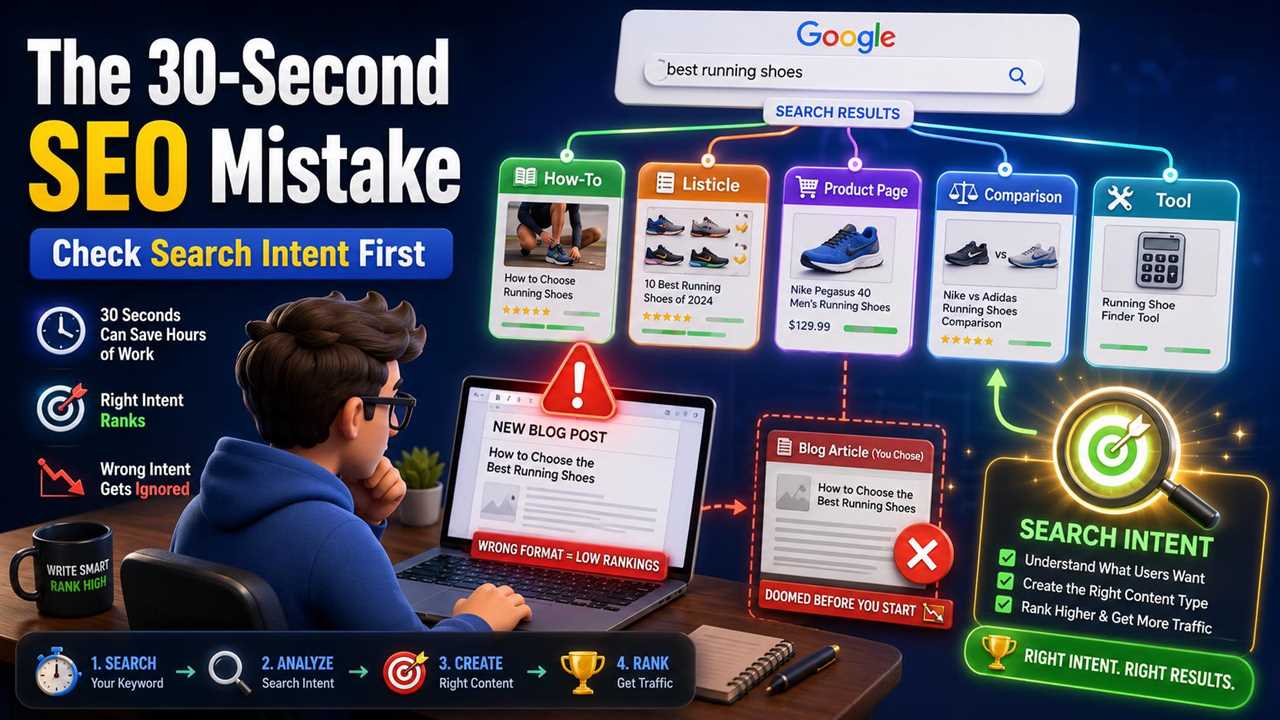
Many writers think ranking in Google starts with writing. It does not. It starts before the first sentence.
The biggest mistake is choosing a keyword and immediately creating content without checking what Google already rewards for that keyword. This creates a silent mismatch. You may write a beautiful blog post, but if searchers want a product page, comparison list, or step-by-step guide, your article may never rank.
This is called search intent.
Search intent means understanding what the person really wants when they type a keyword. Are they trying to learn something? Compare options? Buy a product? Find a tool? Solve a problem? Google’s first page usually gives you the answer.
If the top results are how-to guides, write a how-to guide. If they are listicles, write a listicle. If they are product pages, a blog post may not be the right format. No amount of optimization can fix the wrong content type.
Start With One Keyword and One Clear Purpose
Every strong article should begin with one main keyword.
Trying to target too many keywords at once can make the content scattered. A clear keyword gives the article direction. It tells you what topic to cover, what questions to answer, and what format to use.
Once the keyword is chosen, do a quick search. Look at the top-ranking pages. Study their structure. Notice their titles, headings, subtopics, examples, and depth. This is not about copying competitors. It is about understanding what searchers already expect.
The goal is to match the winning format, then make your content more useful, clearer, and more complete.
Build an Outline Before You Write
A strong outline makes the writing process easier and more strategic.
Look at the pages already ranking for your keyword. What topics do they all cover? Those are the basics your article probably needs. Then look for gaps. What did competitors miss? What questions are still unanswered? What examples, angles, or insights could make your article more valuable?
A smart content outline should include proven topics and unique angles. Think of it as 70% what searchers already expect and 30% what makes your article better than the rest.
"A smart content outline should include proven topics and unique angles. Think of it as 70% what searchers already expect and 30% what makes your article better than the rest."
— Scott, Designer Web Solutions

This step also reduces overwhelm. Instead of thinking, “I need to write a 3,000-word article,” you can focus on one section at a time. Writing becomes simpler when the roadmap is already clear.
Write for Humans, Google, and AI Search
Modern content needs to work for both traditional search engines and AI tools.
That means being clear, structured, and specific. Lead with the answer. If someone searches a direct question, answer it early. Then explain the details underneath.
Use short paragraphs. Long walls of text are hard to read, especially on mobile. Add subheadings every few hundred words so readers can scan easily. Clear headings also help Google and AI systems understand what each section covers.
Facts matter too. AI search tools are more likely to pull from content that contains specific, useful, and verifiable information. Vague advice is easy to ignore. Strong content explains ideas clearly and gives enough context to be trusted.
Internal Links Give New Content a Boost
After writing, many people forget internal links.
Internal links connect one page on your website to another. They help Google discover new content and understand how your topics relate. They also guide readers toward deeper information.
A new article should link out to related existing pages. But existing pages should also link back to the new article. Those incoming internal links help signal that the new page matters.
This is one of the simplest ways to strengthen a post after writing it.
Review Before You Publish
Before publishing, take time to polish.
Read the article out loud. Remove awkward phrases. Simplify anything confusing. Check whether every heading delivers what it promises. Add examples, screenshots, quotes, videos, or visuals when they make the article more helpful.
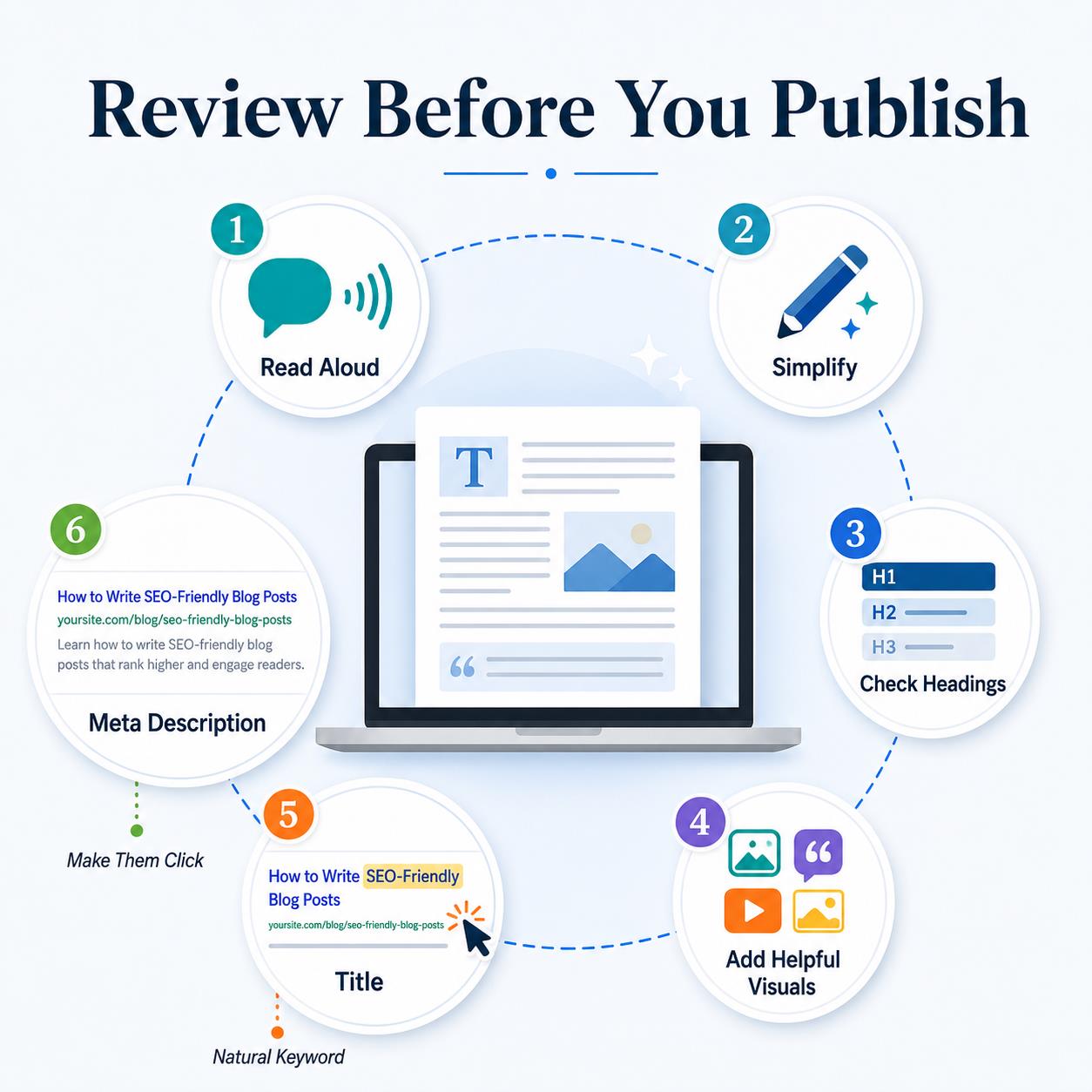
Also review the title and meta description. The title should include the main keyword naturally and make people curious enough to click. The meta description should quickly explain what the reader will get.
Ranking Takes Patience
Publishing is not the finish line. Google needs time to crawl, index, and evaluate content.
Many pages take several months to reach their ranking potential. Check progress after 30, 60, and 90 days. If the page is stuck, study what is ranking above it and improve the missing sections.
Great SEO content is not just written. It is planned, structured, published, measured, and improved.
The real secret is simple: match search intent, cover the topic deeply, make the article easy to understand, and keep improving after publishing.

Frequently Asked Questions

Why 90% of People Are Getting Garbage Results from AI—and
What if I told you the reason most people are disappointed by AI isn't the tool—but how they use it? Every day, millions of people hop onto ChatGPT, Claude, Bard, or any AI tool and type something like, “Analyze my website,” or “Give me marketing ideas,” and get back a pile of vague, surface-level answers.
Read Article →
Mastering ChatGPT in 2025: A Practical Guide to Using the
With over 1. 1 updates per week, ChatGPT is evolving faster than most people can keep up.
Read Article →