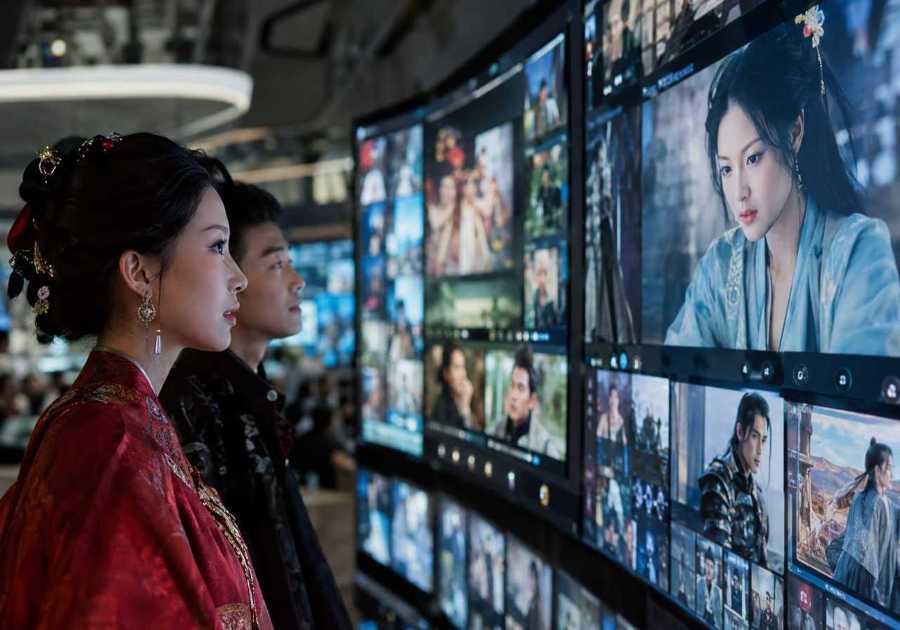
Nine months. 490,000 micro dramas. 850 million viewers.
I read that number twice. Then I did the math. That's roughly 1,800 AI-generated mini-shows released every single day in China, since the start of this year.
I've spent the last eight years traveling full-time, and one thing I've learned is this: watch what people do on their phones in a country, and you'll understand that country. In China, it's micro dramas. Vertical video, 60 to 90 seconds an episode, dozens of episodes per series, built for people scrolling on the subway or waiting in line for noodles. They're already a massive industry on their own. Now add AI into the mix, and the output explodes.
So what actually changed? Studios used to need writers, actors, camera crews, editors, weeks of production time. Now a lot of that gets compressed into something a small team can generate with AI tools, start to finish, in days. Scripts written by AI. Scenes generated by AI. Sometimes faces, voices, entire performances generated by AI. The humans still involved are curating, prompting, directing the machine rather than running the whole show themselves.
I'm not going to pretend that doesn't make me a little uneasy. But I'm also not going to pretend it isn't fascinating.
What Happens When Content Stops Being Scarce?
Here's the question I keep coming back to: what happens to storytelling when the bottleneck disappears?
For most of human history, stories were expensive to make. That scarcity meant something got filtered out before it reached you — bad ideas, half-formed plots, stuff nobody thought was worth the cost of production. Scarcity was a crude but real quality filter.
Take away the cost, and you take away the filter. You get volume instead. 490,000 shows in nine months isn't curated — it's a flood. Somewhere in that flood there are probably a few genuinely good stories. There's also, almost certainly, an ocean of forgettable noise.
I've watched this pattern before, just in different gear. When digital cameras killed the cost of film, everyone became a photographer, and most of us took a lot of mediocre photos before we got better. When blogging got cheap, everyone had an opinion, and the internet got loud. AI micro dramas feel like that same curve, just compressed into months instead of years, and running at industrial scale.
Why This Isn't Just a China Story
It's tempting to read this and think, that's a Chinese tech thing, not my problem. I don't think that's right.
I've met plenty of younger travelers and remote workers over the years who are already using AI to write, edit video, translate, even plan routes. The tools are global. If AI-generated entertainment is pulling in 850 million cumulative viewers in nine months in one country, it's not staying contained to one market. It's a preview.
And here's the part that actually matters to you, whether you're 25 or pushing 70 like I am: the question isn't whether AI can make content. It clearly can, at a scale no human industry ever managed. The question is what you do with the time and attention that frees up.
I didn't start traveling full-time at 60-something because I ran out of things to watch. I did it because I got curious about what happens if you actually go somewhere instead of just reading about it. Real places. Real conversations. Things that don't come with a script, AI-generated or otherwise.
Micro dramas, real or synthetic, are still just dramas. They're not a replacement for sitting in a market in Chiang Mai, lost, asking a stranger for directions in bad local language and getting an actual story out of it. No algorithm writes that scene. You have to go be in it.
So maybe the real takeaway from China's AI drama boom isn't about the technology at all. It's a nudge. If machines can now generate nearly half a million fictional stories in nine months, maybe it's worth asking what you're doing to generate a real one of your own.
What's stopping you from writing the next chapter yourself?
Source: BusinessToday Malaysia
Our last article on this: Google Wants to Put You on TV. Should You Let It?