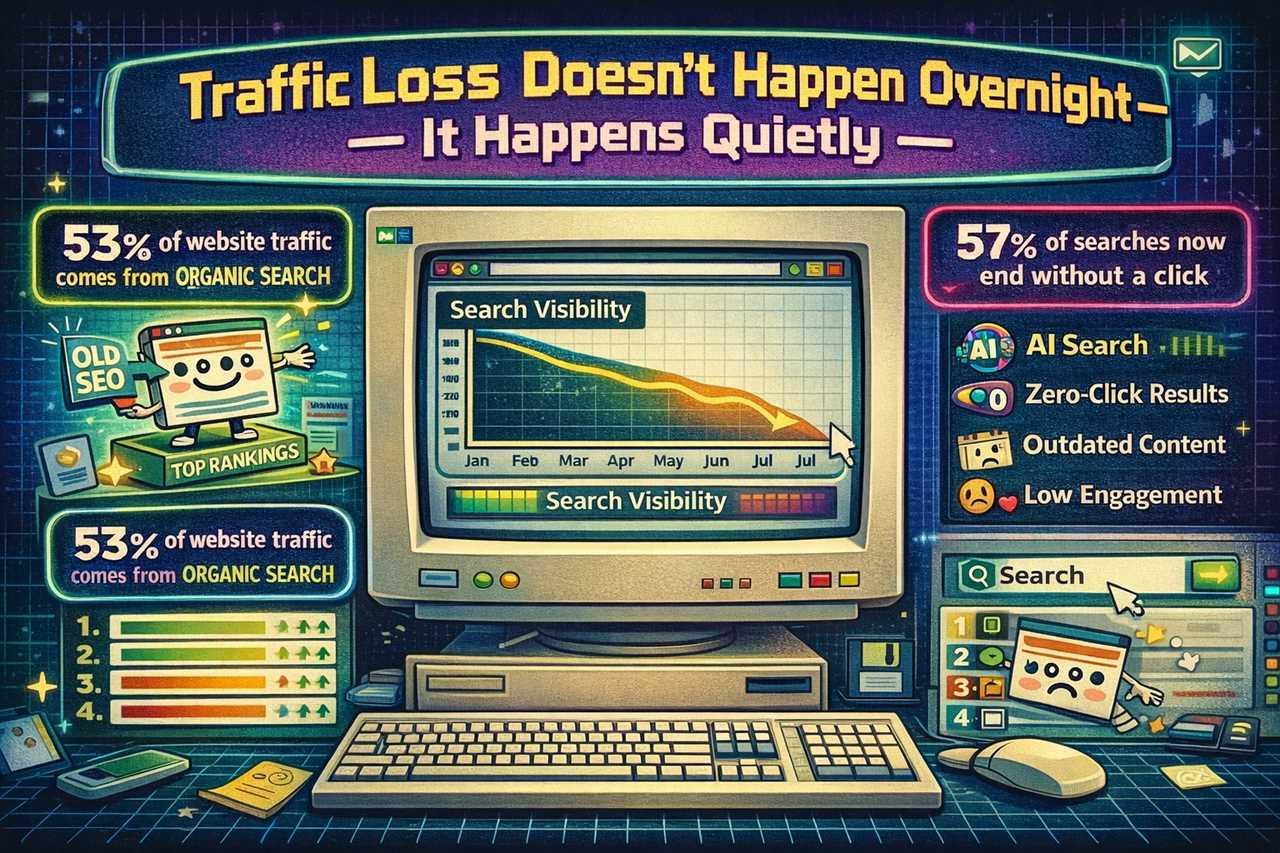
When website traffic drops dramatically, most business owners assume something sudden must have happened. Maybe a major algorithm update rolled out. Maybe a competitor launched a massive marketing campaign. Maybe a technical error broke the website. But the reality is often much less dramatic and far more dangerous: traffic loss rarely happens overnight. It happens gradually, quietly, and often without obvious warning signs.
Many websites lose search visibility slowly over time because they fail to adapt to evolving SEO standards. Rankings slip slightly. Click-through rates decline. Engagement metrics weaken. At first, the changes seem small and easy to ignore. But over months, those small losses compound into significant drops in traffic and leads.
🎥 Watch: Why SEO Traffic Declines Over Time
The Slow Decline of Organic Visibility
Organic search remains one of the most powerful traffic sources online. Studies consistently show that organic search accounts for roughly 53% of total website traffic across industries. Because of this, even small ranking declines can have major long-term consequences.
Consider how search rankings influence user behavior. Research shows that the top three search results receive more than 54% of all clicks, while results ranked lower than position five often receive less than 5% of total clicks. If a website drops from position three to position seven, traffic can fall dramatically—even though the page still technically ranks on the first page.
These gradual shifts often go unnoticed at first. A business owner might see only a slight dip in monthly traffic and assume it’s seasonal. But as the trend continues, the decline becomes harder to ignore.
Algorithm Evolution Is Constant
One reason traffic loss happens slowly is that search algorithms evolve continuously. Instead of dramatic updates happening once or twice a year, search engines now release thousands of small adjustments annually. Some estimates suggest that Google makes over 5,000 changes to its search algorithm every year.
Most of these changes are minor individually. But together they gradually reshape how search engines evaluate content. Websites optimized for older ranking factors slowly become less competitive, while sites using modern strategies gain visibility.
For example, algorithms increasingly prioritize intent, topical authority, and user experience over simple keyword placement. A page that once ranked well because it contained the right keywords may slowly lose ground to content that provides deeper insights and better answers.
Engagement Signals Are Increasingly Important
Another factor in gradual traffic decline is user behavior. Search engines closely monitor how visitors interact with search results. Metrics such as click-through rate, dwell time, and bounce rate help determine whether a page satisfies users’ needs.
If visitors click a result but quickly return to the search page, the algorithm may interpret that as dissatisfaction. Over time, pages with weaker engagement signals can lose rankings.
Statistics reveal that pages with strong user engagement metrics maintain top rankings up to 35% longer than pages with poor interaction rates. This means content quality and user experience directly influence long-term visibility.
Websites that fail to update outdated articles or improve readability may slowly lose engagement. When engagement drops, rankings often follow.
The Rise of AI-Powered Search
The introduction of AI-driven search features has also contributed to gradual traffic shifts. AI summaries, featured snippets, and answer boxes now appear prominently in search results. In many cases, these features provide direct answers without requiring users to click a website.
Recent research indicates that approximately 57% of Google searches now end without a click. This trend, often called “zero-click search,” means that even pages ranking well may receive fewer visitors than they did in previous years.
Businesses that rely solely on traditional SEO tactics may see traffic decline slowly as these new search features capture more user attention.
Preventing the Silent Decline
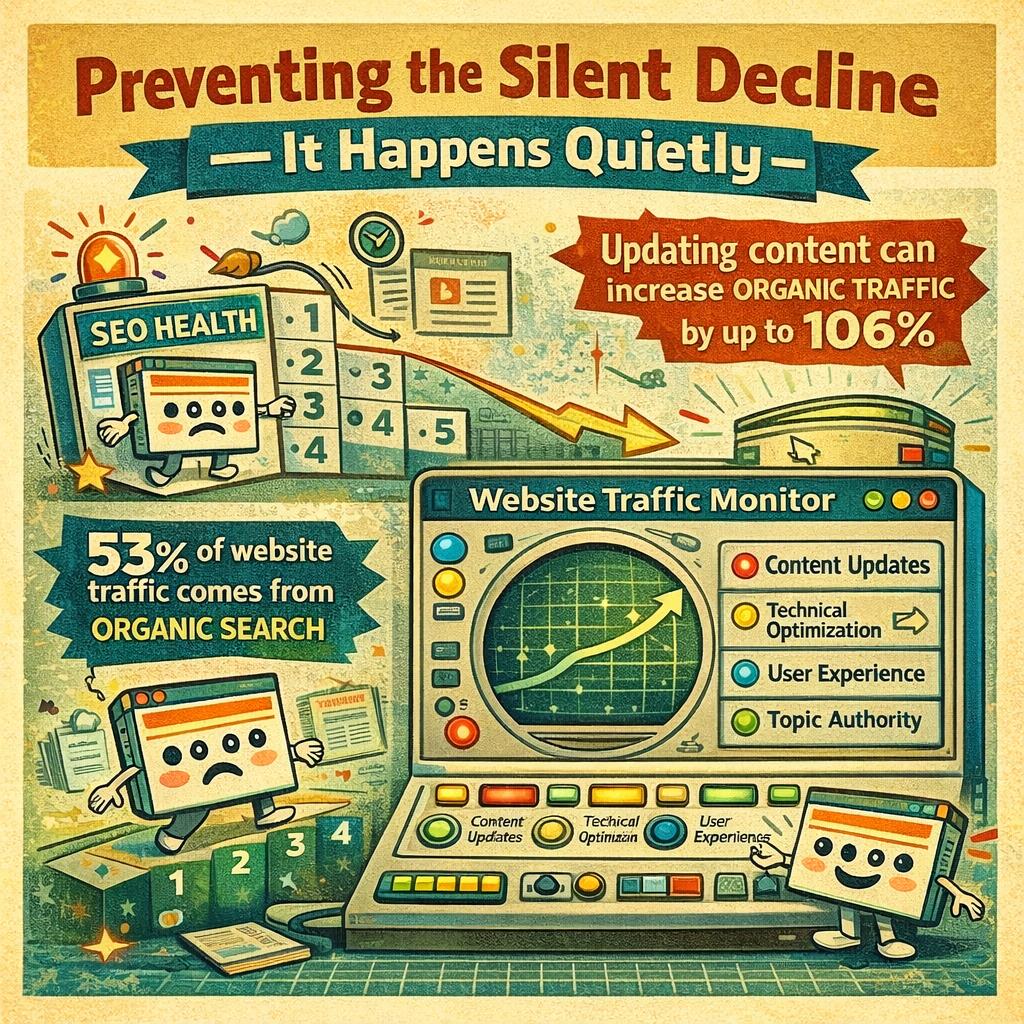
The key to avoiding gradual traffic loss is proactive SEO management. Instead of reacting only when rankings drop significantly, businesses should continuously monitor performance and make strategic improvements.
Regular content updates, technical optimizations, and engagement improvements help maintain search visibility. Tracking analytics data allows businesses to detect early warning signs before traffic declines become severe.
Data from SEO studies shows that updating and improving existing content can increase organic traffic by up to 106%. This highlights how important it is to maintain and refresh older content rather than leaving it untouched.
Most importantly, modern SEO requires understanding how search engines interpret meaning and user intent rather than relying solely on keyword strategies.
If you want to understand the fundamental shift behind modern search algorithms, continue reading
👉 SEO in 2026 Is Not About Keywords Anymore
The Quiet Reality of SEO
Traffic loss rarely feels dramatic in the moment. It often begins as a small decline that gradually grows into a larger problem. Businesses that recognize these early signals can adapt before the damage becomes severe.
The lesson is simple: search visibility is not something you achieve once and keep forever. It requires continuous improvement, adaptation, and awareness of how search engines evolve.
Those who stay proactive maintain their rankings. Those who remain passive often discover the problem only after their traffic has quietly disappeared.
Recommended Resources for AI Content Creation & Business Media Tools
Content is the fastest way to attract customers — and now, AI makes it easier than ever. These tools help you create professional videos, voiceovers, podcasts, and marketing content that make your business stand out and build trust instantly. You don’t need to be tech-savvy or hire expensive creators. With the right tools, you can produce powerful content in minutes and position yourself as the expert in your market. The businesses winning today are the ones creating content consistently. Take a look at the tools below and start creating content that brings you customers.
AI Video & Avatar Tools
HeyGen - Creates AI avatar spokesperson videos without filming.
ElevenLabs - Creates realistic AI voiceovers and voice cloning.
BizClips - Done-for-you business video creation service.
Podcasting, Video & Repurposing Tools
StreamYard - Live streaming studio for broadcasting and recording shows.
Castmagic - Turns podcasts and videos into blogs, posts, and marketing content.
YouTube Growth & Optimization
VidIQ - Helps grow YouTube channels using SEO tools and analytics.
Community & Course Platforms
Skool - Platform for building paid communities and online courses.
Hardware Tools
Maono Microphones - Professional microphones for podcasting and content creation.
Maono GamerWave Mic - USB microphone for podcasting, streaming, and recording.
Mindset & Personal Development
MindTrainer Pro - Programs designed to improve mindset, productivity, and success.